Categories
Out of the Basement and Into the Wild Sue and Ella See America

Congaree

Congaree National Park, SC

During the winter flooding, when you get to a certain point on the wetland boardwalk, the path dips underwater, and you find yourself with your soles in the swamp, unable to go any further. Standing in the water-covered foot path, you have a first-hand, eye-level view of the swamp, and the plant life and cypress trees are amazing. The boardwalk stretches for a few miles in a loop and is the perfect vantage point to enjoy the wilderness of the Congaree River. In the winter months the river rises and covers much of the National Park.

After a snowy trip in the Smokies, Ella and I hit the road for warmer temperatures, making our way to Congaree National Park in South Carolina. Arriving in mid-January, I learned that it is a floodplain park, and all the trails that lead to the Congaree are flooded – but not to worry! – a self-guided, boardwalk tour will tell us everything we need to learn about the park, its biosphere, and its significance.

Congaree National Park Boardwalk

We began the tour on dry ground, but as we walked, we could see the water level rise. The farther we walked, the higher the water rose, until we felt like we were smack dab in the middle of the swamp. I kept stopping to enjoy the view and take pictures, and Ella just had no patience with all that. She wanted to go! Where the water rose to meet the boardwalk, a thick raft of leaves floated on top and gathered along the edges, looking like land. Ella, in her incessant need to explore off-track, stepped off the boardwalk into the water and fell up to her shoulders. Ol’ Ella, the swamp dog.

Swamps are full of the most interesting colors and textures. The mosses, ferns, lichens, mushrooms, and evidence of microbial decay are in glorious abundance, and here in the National Park they are protected. The standing dead trees, called snags, are important to the ecosystem because they provide homes to all kinds of birds, bugs, algae, bacilli, and fungi. Snags and their cousins – fallen dead trees, often as tall as 100’ – are a profusion in this park, so you can imagine the cornucopia of decomposition: mycelium, algae, sludge, gloop, muck, and mire. It was glorious!

With each elevation change, the wildlife also changed. At the highest point, squirrels were squirreling, and gnats were gnatting; there were oaks and pines, ferns, tall grasses, wintering vines, and holly. As we continued, the plant life changed steadily. Saw palmettos began to make an appearance and then giant cypress trees. Owls hooted loudly, and woodpeckers took advantage of the snags. Clumps of algae, moss, and lichens floated on the surface and gathered around eroded tree stumps.

Being able to go no further, we turned around and retraced our steps to the other end of the boardwalk where it culminated at the Congaree. A thick brush of water hickories, sweet gums, laurel oaks, and loblolly pines lined the river on both sides, and the water ran a murky gray-green. It looked like every Alabama river I ever saw.

There are several trails that wind through the middle of the boardwalk loop that have a great representation of fungus and mycelium. Dusty colors of gray, blue, green, and purple on the ripples and folds of lichen foliage popped out of dry-rotted tree stumps and looked like bouquets of spring flowers. Tiny white mushrooms grew in long leggy clusters like small stands of trees trying to outdo each other for the sunlight. As the rains continue through the winter, these trails will probably be covered with water too.

Because the Congaree campground was flooded, we went to a nearby state park, Poinsett, and stayed for the night. It was chilly, the perfect night for a campfire, and this was the perfect park for one. In many state parks it’s hard to find enough wood to build a fire, and, in fact, wood gathering is prohibited. This park, however, was full of dead, dry branches of all sizes and widths. Fire making was a breeze, and Ella and I stayed toasty as we tried to spy the stars peeking out between the canopy of branches above us.

Campfire at Poinsett State Park

Both Congaree and Poinsett were very akin to the topography and biosphere of home. It felt familiar. Almost too familiar. I was ready to see more of the US and its natural wonders. The next morning, we walked, had breakfast, and broke camp, eager for the next leg of our incredible National Park adventure!
Categories
Out of the Basement and Into the Wild Sue and Ella See America

The Smokies

Great Smoky Mountains National Park, Tennessee

The snow was melting from the trees, dropping in small clumps all around us from the bowed branches, making it look like snow was falling from the clear, blue sky. The ground and bare trees were still flocked with white from the previous day’s snowfall, but the temperatures were slowly rising. I don’t know if Ella had ever seen snow before, but she was delighted. She would march ahead on her leash, imploring me to keep up, sticking her nose into little snowy pockets created by visible tree roots. Trampling under the low hanging branches of shrubs and saplings, Ella produced a mini snowstorm wherever she went, then vigorously shook her cold, wet coat.

Most of the Great Smoky Mountains National Park is not dog-friendly, despite having numerous trails of varying abilities, because of the bears and other predatory wildlife and because of the changes dogs bring to the local ecosystem. This is such a completely reasonable and common-sense rule, I never resent it. There are many other beautiful wilderness areas outside the park we can enjoy exploring if we want to.

This National Park seemingly does not have the marked boundaries of other parks, and there are several visitor centers at different entry points because the park borders Tennessee and North Carolina. Ella was only allowed on two trails inside the park boundary, and they were each at different entry points. Since we were arriving late the previous evening after driving from Mammoth Cave, and because the night temperatures were still well below freezing with snow on the ground, we stayed in a hotel in Pigeon Forge near Gatlinburg. Not only would this afford us some warmth, but it would give me a chance to shower and do laundry. After a good night’s rest and completing our ablutions, we headed out to the Gatlinburg Trail.

We followed the trail along and across the Little Pigeon River, and Ella dragged me down to the water’s edge to dip her toes and nose in and take a drink. At one point, we passed some rapids that were flowing over and around rocks, causing a mist, and we inched our way to the river’s bank. It was getting rather muddy, and we did our fair share of slipping and sliding to get this view. The spray rising into the air hovered over the water like fog. The sound of the whitewater rushing and roiling up through the mist while the snow was falling out of the trees all around us was spectacular. We stood for a spell and took it in.

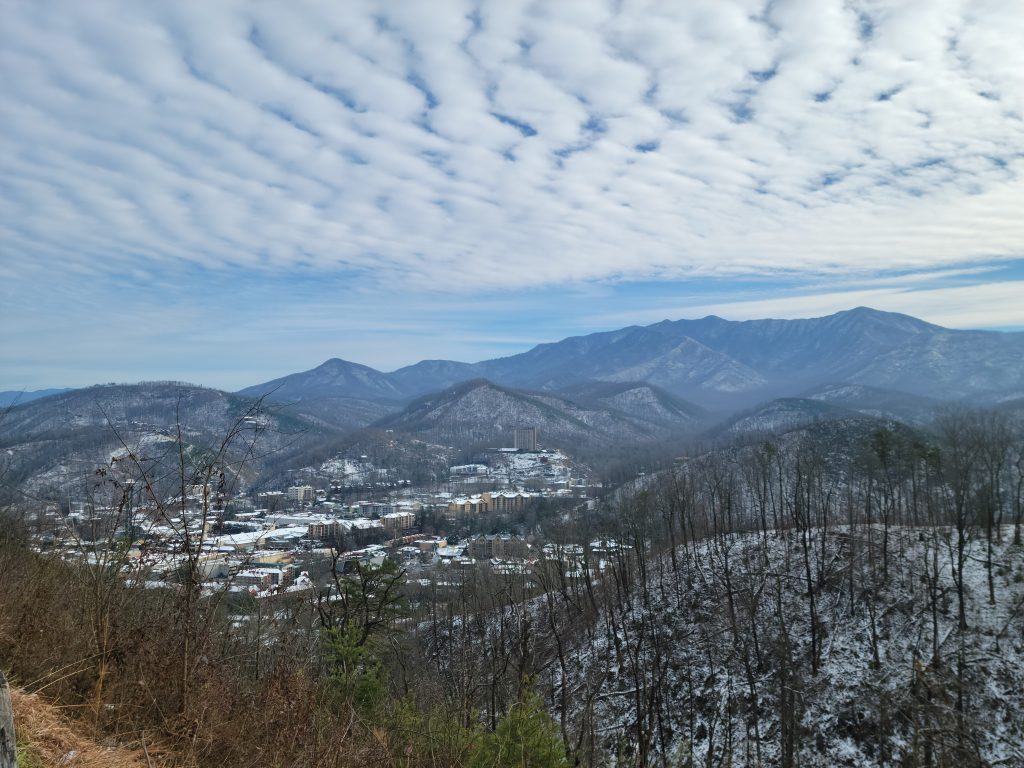
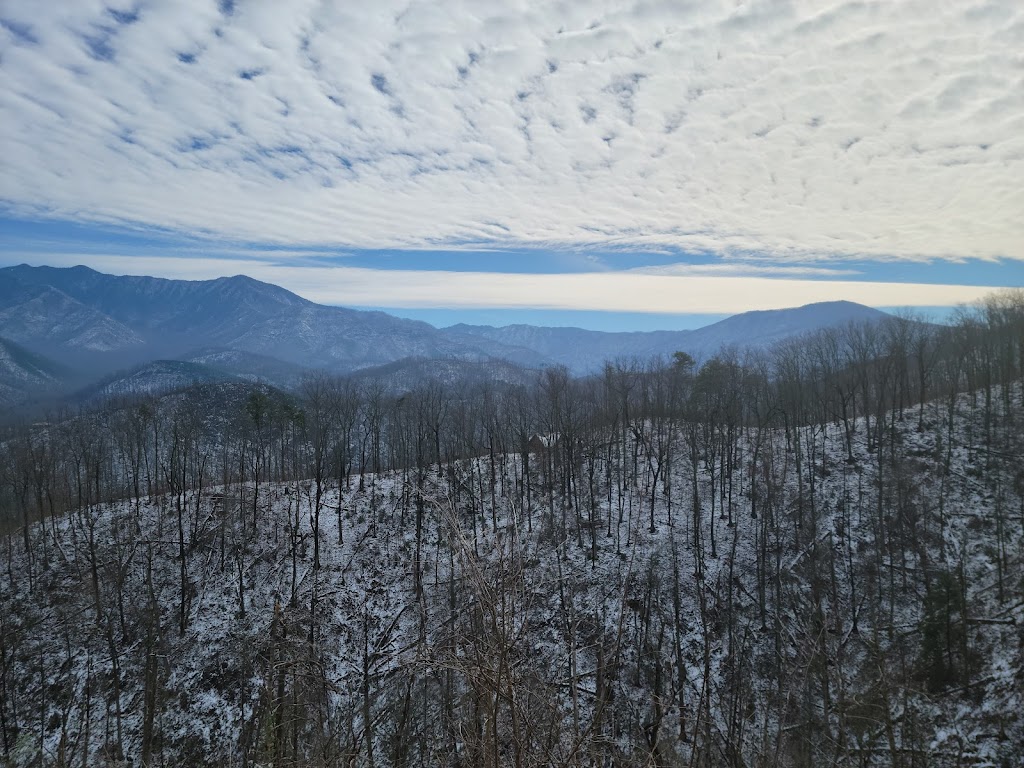
After this satisfying walk, since we couldn’t do much more hiking in the Smokies, I decided to take a scenic drive. Most of the scenic drives were closed, however, because of high water and flooding, but some of the lookouts gave us the classic Smoky Mountain views I was hoping for. Ripples of white clouds were high in the blue sky, and the mountains, covered in evergreens and still spotted with snow, looked gray and purple in the distance, as if they went on forever.

Great Smokies view from Gatlinburg

From there we began our trek south to Congaree to stick with the above freezing temperatures. Driving out of Tennessee was not as picturesque as Kentucky! One of the roads on our route was closed because of flooding, so the GPS redirected us through a small town of old, battered farmhouses and rusted trailers. More and more the town appeared to be filled with old cars – 1970s models with no wheels and missing doors, tractors on cinder blocks, wrecked trucks abandoned in fields. Although it made no sense, at one point I really thought we were in the middle of a junkyard, lost. There were tires and heaps of parts from cars that were half a century old on both sides of the street, and the road was winding in such a way that I couldn’t see ahead. We were the only ones on the road, which was further unsettling. What snapped me into reality was a sign that read, “Slow, school bus ahead.” I felt immediate relief that I was indeed on a road through a normal, small, rural, American town but also dispirited by its dystopian air.

My downheartedness quickly turned to awe as I began the passage through TN into NC, with the Smokies rising up majestically on both sides of us. The road winds through the middle of the range, and the mountains are giant, formidable, and breathtaking. I felt strangely and wonderfully humbled in their midst.